



Next-Generation Solutions for Medical Device Disinfection
As medical device technologies become increasingly complex and sensitive, the disinfection methods that ensure these devices can be safely reused are also undergoing a major evolution. Replacing traditional methods, “Next Generation Solutions” aim not only to eliminate microorganisms, but also to preserve device lifespan, enhance user safety, and automate the process.
At Detrox, we offer healthcare professionals the most reliable “next-generation” solutions with our products that set global standards in medical device and endoscope disinfection.
Enzymatic Cleaning: The Molecular Solution for Invisible Contaminants
Cleaning is the first and most critical step in disinfection. If organic waste (blood, protein, grease) on a medical device is not completely cleaned, the disinfectant cannot reach the microorganisms.
Leading the way in new generation solutions, Detro Enzym, Detro Enzym M, and Detro Enzym Plus break down the bioburden at a molecular level thanks to their four- and five-component formulas. This technology minimises the need for scrubbing, reducing the risk of injury to staff and preventing mechanical wear on sensitive medical devices.
The Peracetic Acid Revolution in High-Level Disinfection
Aldehyde-based solutions, which were widely used in the past, are being replaced by more ecological and faster solutions due to their impact on both the environment and user health.
Peracetic acid-based solutions such as Detro Plus PAA, Detro PAA 1500, Detro PAA 2200, and Detro Activ represent the pinnacle of new-generation disinfection. They demonstrate full-spectrum efficacy, including sporicidal activity, in just 5-10 minutes. Since they completely break down into water and oxygen after use, they leave no residue and are environmentally friendly.
Detroscopy: Automation and Standardisation
Human error is the weakest link in the infection control chain. New-generation disinfection strengthens this link with automated systems.
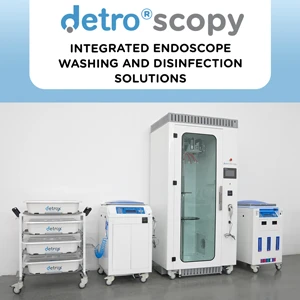
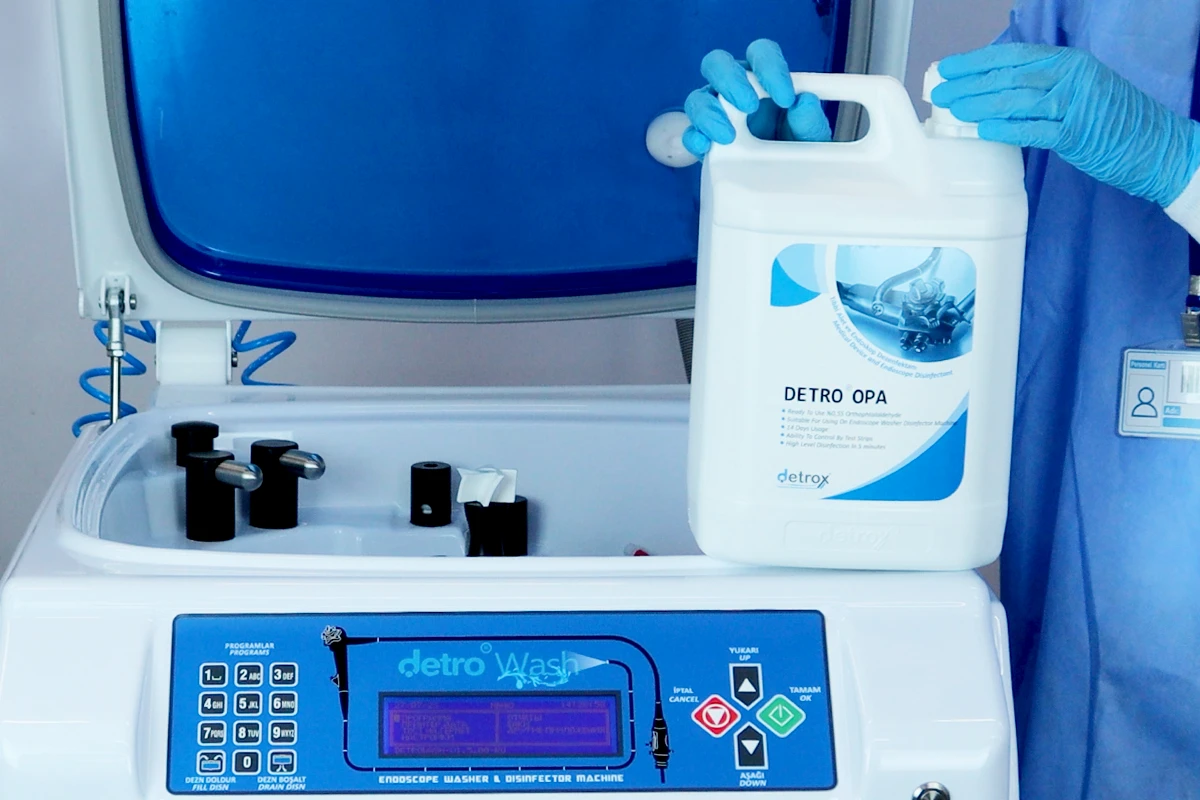
The Detroscopy series (Endoscope Washing and Disinfection Devices) developed by Detrox standardises the entire process. It ensures that the device’s channels are fully exposed to the disinfectant, performs leak tests, and digitally reports each process. This is indispensable for modern hospitals in terms of both patient safety and legal traceability.
Material Compatibility: Protect Your Investment
Next-generation solutions must be not only “lethal” but also “protective.” Flexible endoscopes, surgical instruments, and anaesthesia equipment are costly investments.
The formulas developed at the Detrox R&D centre are enriched with corrosion inhibitors. This means that while they are highly aggressive against microbes, they are gentle on the device’s stainless steel, plastic, or optical components.
Compliance with Regulations and Standards
All our products used in medical device disinfection have passed the 93/42/EEC Medical Device Directive and relevant EN (European Standards) tests. Detrox solutions facilitate the audit processes of healthcare institutions with their effectiveness, which has been approved by accredited laboratories.
Frequently Asked Questions (FAQ)
Question 1: What is the main difference between manual disinfection and automatic washing machines? Answer: Manual processes always carry the risk of dosing errors, time tracking errors, and channel washing errors. Automatic systems (e.g. Detroscopy) eliminate human error by applying the same standard parameters (temperature, time, concentration) in every cycle and protect personnel from exposure to chemical vapours.
Question 2: How do you decide whether a medical device needs to be “disinfected” or “sterilised”? Answer: The “Spaulding Classification” is used as a basis for this. Devices that enter sterile areas of the body (surgical instruments) must be sterilised. For devices that come into contact with mucous membranes but do not enter sterile areas (endoscopes), “High-Level Disinfection” using peracetic acid or OPA is sufficient and is the standard method.
Question 3: Do peracetic acid-based products damage instruments? Answer: Pure peracetic acid can be corrosive, but specially formulated products such as Detro PAA contain corrosion inhibitors. They are fully compatible with stainless steel and endoscope materials as long as the specified contact times are observed.
Question 4: Why do enzymatic cleaners not provide disinfection on their own? Answer: The role of enzymes is not to kill microbes, but to break down the organic layer (biofilm) in which microbes hide. Disinfection cannot be performed without cleaning, but the cleaning stage does not completely eliminate microorganisms. Therefore, a high-level disinfectant must always be used after cleaning.
Question 5: Can rapid surface disinfectants be used in the internal channels of medical devices? Answer: No. Alcohol-based rapid sprays are only suitable for the external surfaces and cables of devices. Complex devices with internal channels must be disinfected using immersion methods or automatic devices.